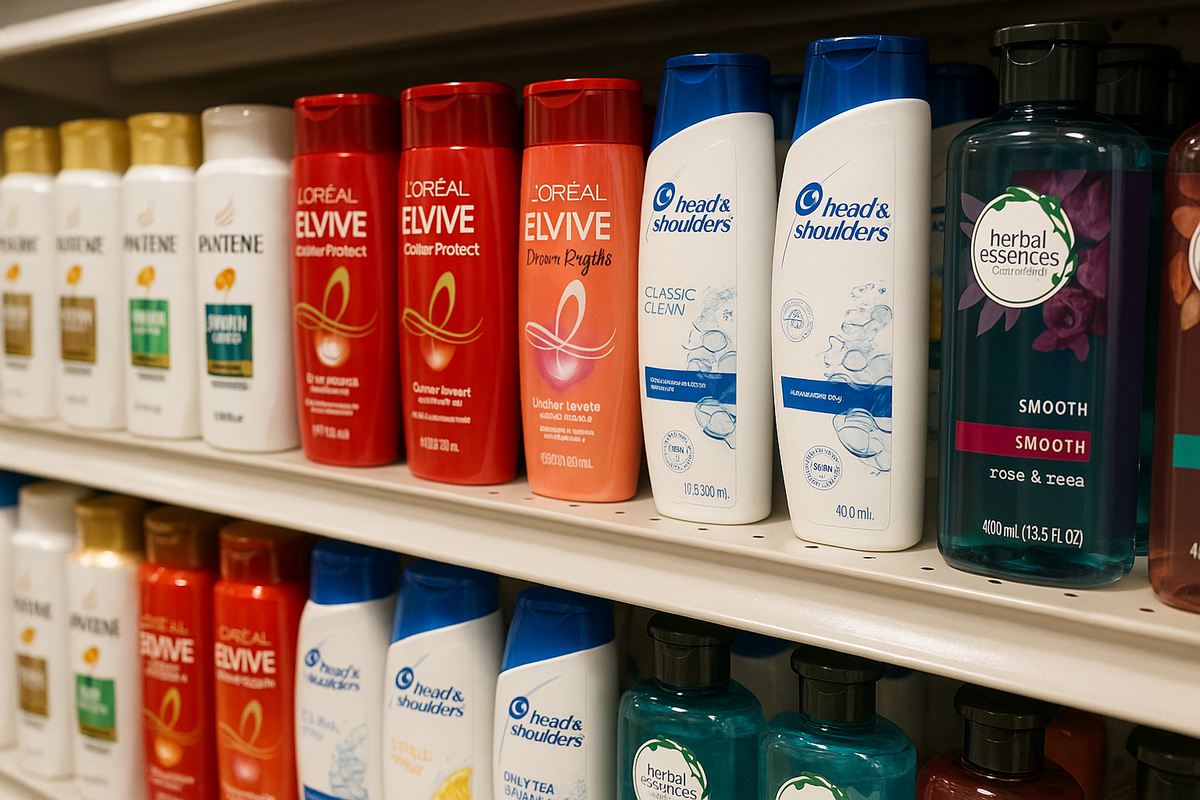
Most people have stood in front of a supermarket haircare aisle at some point and wondered what they would actually be getting for four times the price somewhere else.
The bottles look similar. The claims are close to identical. Shine, strength, repair, volume, all promised in roughly the same font. And yet the brands your hairdresser uses cost considerably more and are sold in completely different places.
So it is worth asking properly: are salon brands genuinely better, or is it mostly reputation?
The short version is that it depends on what your hair is dealing with. If your hair is uncoloured, rarely heat-styled and generally well behaved, the gap is smaller than the price difference suggests. If your hair is coloured, dry, fine, oily, curly or damaged, the gap gets wide very quickly.
Here is what actually separates the two, which brands do what, and how to work out whether the switch is worth it for your hair.
What "Salon-Grade" Actually Means
The phrase gets used loosely, so it helps to pin it down. A professional brand is one developed for stylists to use every day, on every hair type that walks through the door, with results that have to hold up under someone else's professional reputation.
That has three practical consequences. Formulas are built around performance first and price second. Ranges are built as systems rather than single bottles, so a shampoo has a matching conditioner, treatment and finishing product designed to work with it. And products are split by hair type and concern instead of averaging everyone together.
Supermarket brands are built to a different brief entirely. They have to work acceptably for as many people as possible at a price that survives a promotional cycle. That is a legitimate thing to optimise for, and it is simply a different job.

The Formulation Difference, in Plain Terms
A quick bit of formulation, because everything else makes more sense once you know how these products are built.
Almost every shampoo, conditioner and treatment on the market is mostly water. In a shampoo, the ingredient doing the actual cleaning is a surfactant, which grabs oil and residue so the water can rinse it away. That cleansing step is broadly similar at both price points.
The difference lives in everything sitting behind it:
- conditioning agents that smooth the cuticle
- proteins and amino acids that support hair structure
- humectants that draw in and hold moisture
- oils and lipids that replace what washing strips out
- scalp actives that target oil balance, flaking or density
- pH adjusters that stop a formula roughing up the cuticle
That secondary system is the expensive part, and it is the first thing cut when a formula has to hit a shelf price. It is also why professional products are more concentrated, and why the directions usually ask for a much smaller amount than you are used to using.

Salon Brands Are Built for Specific Hair, Not Everyone's
Mass-market haircare has to suit the widest possible audience. One shampoo, one conditioner, a broad promise of healthy hair.
The trouble is that hair is not one thing. Fine hair gets weighed down by formulas that coarse hair barely notices. An oily scalp and dry ends need almost opposite treatment. Colour-treated hair needs cleansing that does not strip the tone out of it within a fortnight.
Professional brands are formulated around those differences, which is why we can stock separate ranges for fine hair, oily hair, dry hair and coloured and treated hair rather than one bottle claiming to cover all of it.
Matching the formula to your hair matters more than which shelf it came from. If you are not sure where you sit, our two-minute Hair Quiz narrows it down by hair type, scalp needs and main concern.
Cheap Shine Wears Off, and It Costs You Later
Budget formulas often lean on heavy silicones to make hair feel instantly soft and look glossy the moment it dries. It works beautifully. That is precisely the problem.
Silicones coat the outside of the hair. They do not strengthen anything underneath, and with repeated washing that coating builds up faster than a gentle shampoo can remove it. Over a few months the effect reverses, and you are usually looking at:
- hair that looks flat and sits heavy at the roots
- dullness that conditioner no longer fixes
- colour that fades faster than it should
- product that stops absorbing and sits on the surface
- ends that still feel dry despite everything
Then the compensating starts. A volumising spray for the flatness, a serum for the dullness, a clarifying wash to strip the build-up, and suddenly the cheap shampoo has three other products propping it up.
Professional formulas are designed to work on the hair and scalp themselves, so results build slowly and hold between washes. Less impressive on day one, considerably more impressive by week six.

The Salon Brands We Stock, and What Each One Is For
Professional brands are not interchangeable. Each one was built around a particular problem, which is why stylists tend to mix and match rather than committing to a single label. Here is the short version of who does what.
Olaplex, for structural damage
Olaplex is built around bond-building technology, which targets the disulfide bonds inside the hair fibre that bleach, permanent colour and high heat break down over time.
This is a repair range rather than a general-purpose one. It makes the most sense if your hair has been coloured, chemically processed or heat-styled to the point where it feels weaker and more fragile than it used to.
Nioxin, for the scalp
Nioxin approaches thinning and density from the scalp rather than the strand, using cleansing and treatment steps designed to improve the scalp environment.
Its System kits are sold as numbered sets for a reason. The shampoo, conditioner and leave-in treatment are meant to be used together, which is a very different proposition to one bottle doing everything.
Pureology, for colour
Pureology formulas are sulphate-free and designed to hold colour for longer between salon visits, which is where frustration with cheap haircare usually shows up first.
If you are paying for colour every six to eight weeks, what you use in between has a real effect on how much of that money survives the fortnight.
Moroccanoil, for smoothing and shine
Moroccanoil built its reputation on argan oil formulas, and the Original Treatment remains one of the most recognisable finishing products in the industry.
It suits frizz-prone, coarse or dry hair particularly well, and it is an easy first upgrade if you want a noticeable difference without changing your whole routine.
Redken and Matrix, for range
Redken and Matrix both run broad professional ranges spanning strengthening, colour care, toning and styling.
Between them they cover most everyday concerns, which makes either a sensible starting point if you want to upgrade a routine without committing to a specialist system.
Joico and Davroe, for repair and gentler formulas
Joico is known for its bond and repair ranges, particularly for hair that has been through a lot of colour work.
Davroe takes a different angle again, with sulphate-free, vegan formulas built around botanical ingredients for people who want professional performance from a gentler base.

How to Spot a Properly Built Formula
You do not need a chemistry degree to get a rough read on a product. Ingredient lists run in descending order of concentration, at least for everything above about one percent, so position tells you a lot.
- Water first is normal. Almost everything starts there. It tells you nothing on its own.
- Find the surfactant in a shampoo. Usually second or third. Sulphate-free alternatives are the better fit for coloured or dry hair.
- Look at what comes next. If the following ingredients are mostly fillers and fragrance, the formula is thin. Proteins, amino acids, oils and conditioning agents fairly high up mean there is something in there.
- Spot the silicones. They usually end in "cone", "conol" or "siloxane". High on the list means heavy coating and likely build-up.
- Read the directions. A product that asks for a small amount is telling you it is concentrated. One that wants a generous palmful twice is telling you the opposite.
None of this is foolproof, and a well-built product can still be wrong for your hair. It is enough to tell a properly formulated range from a heavily diluted one, which is most of the battle in an aisle.

When Supermarket Brands Are Genuinely Fine
Not everyone needs to upgrade, and pretending otherwise would be a bit rich coming from a haircare shop.
If your hair is uncoloured, short or mid-length, rarely heat-styled and behaves itself between washes, a supermarket brand will probably keep doing the job. Hair that is not under any real stress does not need much help.
The case for switching gets much stronger once there is a specific problem to solve. Colour that fades fast, a scalp that swings between greasy and irritated, ends that snap, curls that have lost definition, or fine hair that goes flat by lunchtime are all things a targeted range can actually address.
Your haircare should solve a problem you have, not one you have been told to worry about.
So, Are Salon Brands Worth It?
For most people with a specific hair concern, yes, but the reasoning matters more than the verdict.
The value sits in concentration and formulation, so it only pays off if you use the products as directed. A small amount, a range matched to your hair, and enough consistency to let it do something. Use a professional product the way you used a supermarket one and you will spend more money for very similar results.
You also do not need to switch everything at once. Most people get the clearest result by upgrading the product that touches their hair most often, then building out from there.
If you are working out where to start, start with the problem:
- Colour fading too fast? Pureology, or another sulphate-free colour-safe range.
- Hair snapping or feeling fragile? Olaplex is the obvious first stop.
- Scalp concerns or thinning? Nioxin is built specifically for that.
- Frizz and roughness? Moroccanoil is a good place to begin.
- Genuinely not sure? Take the Hair Quiz or send us a message.

How to Get More Out of Salon Products
Switching brands is only half of it. A few habits decide whether the upgrade is worth what you paid.
Use far less than you think
This is the one people get wrong most often. Start with roughly a 20-cent coin of shampoo, emulsify it in your hands, and only do a second wash if your hair is genuinely still coated.
Give it more than one wash to judge
Professional formulas work on hair condition rather than instant surface feel, so the first wash can even feel slightly less soft if you are coming off a silicone-heavy product. Give it three or four washes before deciding.
Keep the system together where it matters
Shampoo and conditioner from the same range are developed to work as a pair, and repair systems like Nioxin are designed to be used as a set. Elsewhere, mixing brands is completely fine.
Clarify occasionally, not constantly
If you are switching from a build-up-heavy routine, one clarifying wash helps reset things. Doing it weekly just strips your hair and undoes the point of the change.
Shop Salon Brands at Holy Grail Haircare
Salon-grade haircare has traditionally come with salon-grade pricing, and that is the bit we set out to change.
We stock Olaplex, Pureology, Moroccanoil, Redken, Matrix, Nioxin, Joico, Davroe and more at prices that make sense for everyday use, with free NZ-wide delivery on orders over $75.
If you are still unsure which brand suits your hair, send us a DM describing what your hair is actually doing and we will point you at something sensible. That is a service the supermarket aisle has never once offered you.
Browse the full range to get started.
FAQs
What does salon-grade actually mean?
It refers to brands developed for professional use, where formulas are built around performance first and sold as systems rather than single products. In practice it means higher concentrations of active ingredients and ranges split by hair type and concern.
Are salon brands really better than supermarket brands?
For hair with a specific concern, usually yes, mainly because of ingredient concentration and targeted formulation. Supermarket brands are designed to suit everyone reasonably well, which in practice means they do not excel for anyone.
Why are salon brands more expensive?
More of the formula is active ingredient and less of it is water and filler, and professional brands invest more in formulation and testing. Because the products are concentrated, the cost per use is much closer than the cost per bottle suggests.
What brands do salons use?
It varies by salon, but most stock professional names such as Redken, Matrix, Olaplex, Moroccanoil, Joico and Schwarzkopf. Those are the same brands available at Holy Grail Haircare, without the salon price tag.
Do I need to use a whole range from one brand?
Not usually. Shampoo and conditioner pairs and repair systems like Nioxin are designed to be used together, but beyond that, mixing brands to suit different needs is completely normal and is what most stylists do anyway.
Are salon brands better for coloured hair?
Generally yes, because colour-safe professional formulas are typically sulphate-free and designed to cleanse without stripping tone. If you are paying for colour regularly, what you use between appointments has a real effect on how long it lasts.
Is sulphate-free always better?
Not always. Sulphate-free formulas are gentler and a good match for coloured, dry or sensitive hair, but they lather less and can leave build-up on scalps that produce a lot of oil. Oily hair often does better with a balancing or clarifying formula used regularly.
How long do salon products last?
Used at the recommended amount, professional products typically last noticeably longer than the bottle size suggests, because the doses are smaller. If a bottle is disappearing quickly, you are almost certainly using more per wash than the formula needs.